Strategic Leadership, Moderation, and Operational Synthesis.
Gulf & MENA Decision-Makers Forum 2026Dubai 5th October 2026
EXECUTIVE CASE STUDY
Strategic Leadership, Moderation, and Operational Synthesis
The Inaugural Gulf & MENA Decision-Makers Forum (Dubai 2026)
Executive Leadership & Moderation: Strategic Chair and Moderator (Ammar Hina, NEP Middle East & Asia)
Event Host: NEP Middle East & Asia
Initiative & Media Lead: TFT1957
Technology & Event Partners: wTVision, Bridge Technologies, TVU Networks
Participants, Panel 1: Elie Rukouz – AFG AF, Hamad Abdulrazzaq – DMI, Anas Attamneh – Eurovision, Mudathir Abdulraouf – Thamanya, Ben Kimber – MBC, Omar Plette – Mediapro, Oscar Teran – EVS, Jorge Simao – Eurovision, Jamal Abdulnasser – PLC, Feizel Bacha – Genius Sports, Diogo Açafrão – ADM LIVEHD, Hugo Guerreiro – AlKaas, Mohammad Buita – EVS, John Curtis – Whisper, Halid Najjar – NEP, Jacob Mclinton – NEP, Abdulelah Alhemayd – MBC, Mocef Ayeb – Eurovision, Ahmad Hanafy – MBC, Michelle Dwaik – WTV, Emad Qawasmi – TVU, Rafael Castello – TVU, Paolo Limo – Bridge Technologies, Andre Chagas – WTV.
Panel 2: Nawaf Al Sullami – Mediapreneur (CEO), Anas Attamneh – Eurovision, Hasan Sayed – Mastersmedia, Dipesh Makwana – Alibaba, Omar Alzoubi – DMI, Mustafa Tell – ART, Galal Hakim – Transform Media, Rama AlDairi – beIN MEDIA GROUP, Abdulelah Alhemayd – MBC, Ibrahim Al-Jabry – Asharq, Mudathir Abdulraouf – Thamanya, Jorge Simao – Eurovision, Mousa Teif – Eutelsat, Mocef Ayeb – Eurovision, Ahmad Hanafy – MBC, Jean Claude Rahme – NEP, Iurii (Yury) Polonskii – NEP, Paolo Limo – Bridge Technologies, Andre Chagas – WTV, Michelle Dwaik – WTV, Emad Qawasmi – TVU, Rafael Castello – TVU.
Format: Closed-Door Executive Forum (Strict Non-Commercial Policy, Zero Product/Vendor Pitches, Direct C-Suite Dialogue)
1. Executive Summary & Macro Industry Context
The Middle East and North Africa (MENA) media and entertainment sector has entered a transformative era, with market valuation surpassing $40 billion. Massive capital investments are reshaping sports leagues, regional events, and TV broadcasting networks across the GCC and wider MENA region. However, as the industry transitions toward full digital operations, decision-makers are caught between traditional production architectures and next-generation automated, software-driven workflows.
To address these strategic realities without vendor distraction, TFT1957 launched the Gulf & MENA Decision-Makers Forum, with NEP MENA hosting the inaugural meeting in Dubai. Serving as Strategic Chair and Moderator, Ammar Hina facilitated both executive roundtables. The forum convened C-level executives, technical directors, engineering leads, sports rights-holders, and broadcast strategists from leading regional entities (MBC Group, beIN MEDIA GROUP, Dubai Media Inc. [DMI], Abu Dhabi Media [ADM LIVEHD], ALKASS, Asharq, Thamanya, Asia Football Group [AFG], UAE Pro League [PLC], Whisper, Mediapro, EVS, Genius Sports, and Eurovision Services).
2. Forum Governance & Strategic Moderation Framework
● Non-Commercial Mandate: A strict rule prohibited vendor pitches or product self-promotions. Discussions focused purely on industry challenges, architectural models, and strategic solutions.
● Peer-Level Expertise: Assembled seasoned leaders with extensive regional and global broadcast experience to evaluate real-world execution against financial constraints.
● Cross-Sector Dialogue: Bridged structural gaps between non-technical sports executives, rights-holders, broadcast producers, and lead engineers.
● Actionable Synthesis: Directed the dialogue toward actionable consensus regarding procurement reform, telecom engagement, cloud architectures, AI integration, and multi-format distribution.
3. Comprehensive Breakdown: Roundtable 1
Focus: Sports, Large-Scale Events, Procurement, Telcos & Fan Habits
Topic 1: Large-Scale Event Infrastructure & Procurement Reform
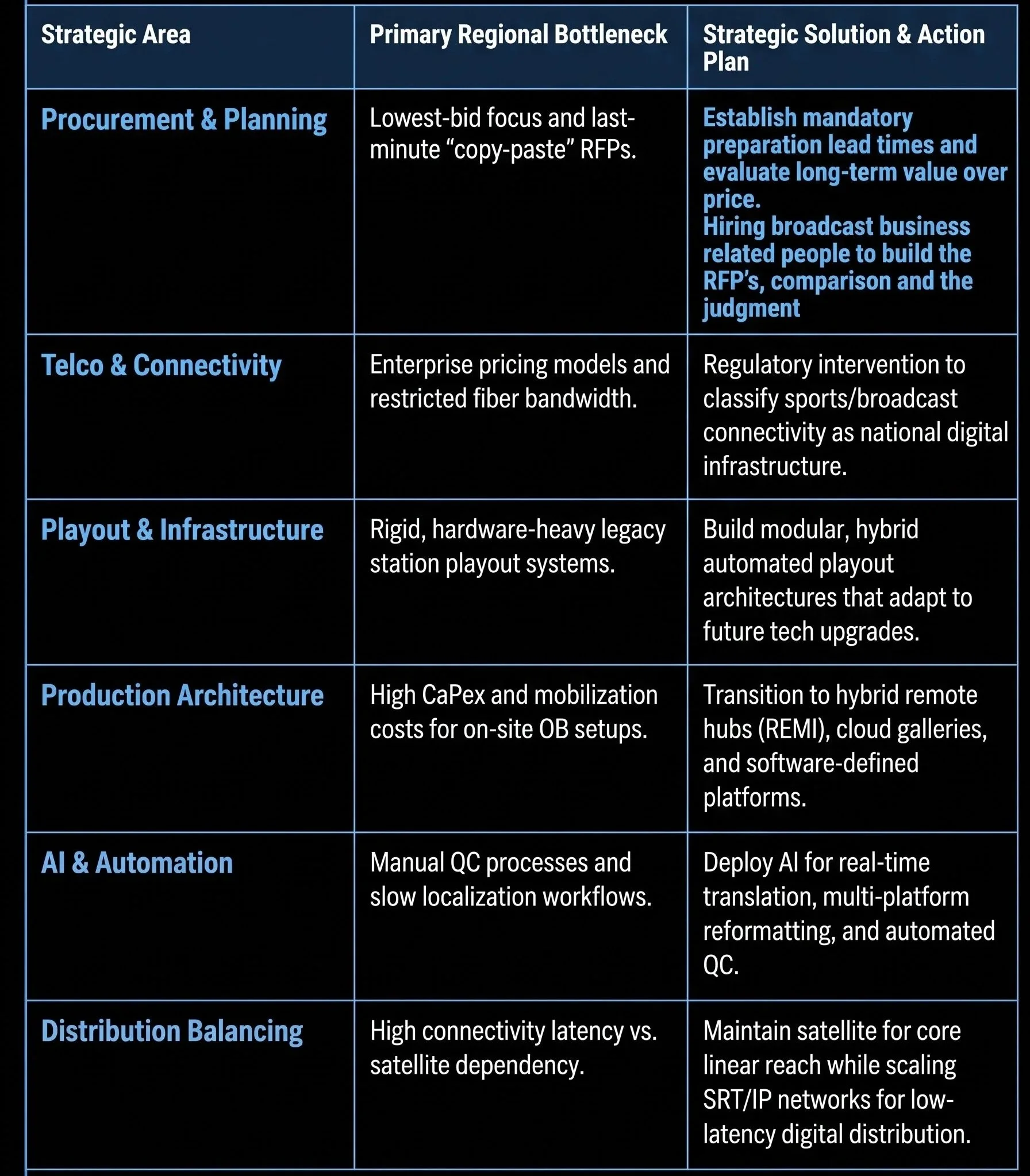
● The Procurement Bottleneck: Participants highlighted that regional procurement departments treat broadcast services as routine commercial purchases. Relying strictly on the lowest bidder and issuing last-minute RFPs stifles innovation, forces technical compromises, and damages overall project delivery.
● Outdated "Copy-Paste" RFPs: Sports organizations frequently reissue outdated RFP templates without evaluating modern technologies or the long-term ROI of investing in higher-quality production standards.
● Prerequisites for Quality: Executives, directors, and engineers agreed that clear output direction, adequate preparation time, realistic budgets, and mutual operational trust are mandatory to elevate broadcast quality.
● Production Architecture: Evaluated Remote Production (REMI), Baseband, and Cloud Workflows, concluding that REMI is a primary catalyst for scaling match coverage economically while maintaining top-tier output.
Topic 2: Fan-Centric Strategies & Modern Consumption Habits
● The Fan as the End Customer: Broadcast strategy must pivot toward fan consumption habits rather than organizational habits. Audiences increasingly prioritize short-form clips, vertical formats for mobile, interactive second-screen feeds, and AR/VR integration.
● Cinematic & Gaming Visuals: Shallow depth-of-field cinematic cameras and gaming-style graphics overlays stem directly from younger demographic expectations for immersive entertainment.
● AI & Operational Upgrades: AI, robotics, and automated Quality Control (QC) help production teams work faster and smarter. Analyzing fan data allows creative teams to build better visual storytelling and generate new social monetization streams.
Topic 3: Telecom Infrastructure & Connectivity Barriers
● The Telco Bottleneck: Regional telecom companies treat sports broadcasters as standard enterprise clients, charging high bandwidth prices and restricting dedicated fiber capacity.
● Commercial & Operational Impact: Excessive connectivity fees reduce profitability and limit production throughput, restricting the deployment of remote production hubs.
● Regulatory Intervention: Government regulators and telecom boards must treat sports broadcasting as essential digital infrastructure. While 4G/5G bonding serves smaller productions, Tier-1 mega-events require dedicated, low-latency fiber collaboration.
Topic 4: Multi-Format Balancing (SD, HD, HDR, 4K UHD, Linear & OTT)
● Demographic Variety: MENA spans high-ARPU regions demanding 4K UHD HDR via OTT alongside lower-income markets relying on basic SD/HD satellite linear feeds.
● Targeted Multi-Output Architecture: Decision-makers must evaluate audience consumption habits before committing CapEx, building systems that natively produce multi-format feeds tailored across all distribution endpoints.
4. Comprehensive Breakdown: Roundtable 2
Focus: TV Stations, Cloud Galleries, AI Tools, Playout Automation & Distribution
Topic 1: Transitioning Traditional TV Infrastructure to Hybrid Digital & Automated Playout
● The Speed vs. Quality Formula: The industry faces a shifting dynamic: in news media, speed often outweighs visual fidelity ("fast information is worth more than best quality"), whereas sports broadcasting demands top-tier visual and technical quality.
● Upgrading Without Replacing: TV channels must modernize playout and transmission systems without overhaul. The consensus highlighted designing flexible infrastructure tailored to specific channel needs, guided by technical experts.
● Near-Term CapEx vs. Long-Term Value: Decision-makers must weigh immediate upgrade costs against long-term flexibility. Investing in adaptable, future-proof digital architectures yields far higher efficiency over time.
Topic 2: AI Integration in News, Linear Workflows, and Quality Control (QC)
● Content Generation & Localization: AI tools are transforming linear and digital news production, streamlining automated subtitling, real-time language translation, metadata tagging, and multi-platform re-formatting.
● QC Automation & Distribution: AI-driven Quality Control tools instantly detect audio/video artifacts, compliance errors, and formatting mismatches, enabling automated, error-free distribution across multi-screen outputs.
● Unlocking Value: TV stations must understand that AI is an operational multiplier that frees creative teams to focus on high-value storytelling.
Topic 3: Centralized Production vs. Traditional On-Site Setups & Cloud Galleries
● Operational Efficiency: Transitioning from traditional on-site galleries to centralized remote hubs and cloud-based galleries drastically reduces operational costs while guaranteeing speed and quality.
● Industry Adoption Gap: While forward-thinking MENA broadcasters are actively deploying cloud and remote galleries, many regional players remain stuck in traditional, hardware-heavy workflows.
● Architectural Clarity: The session defined clear operational frameworks for Cloud, Hybrid, Remote Hubs, and Centralized Production, providing decision-makers with a blueprint for future infrastructure planning.
Topic 4: Distribution Networks, IP Centricity, Latency & Satellite Realities
● IP Networks & Latency: Balancing SRT, IP-centric networks, and cloud distribution requires solving regional latency and telecom bandwidth challenges.
● The Future of Satellite: Unanimous agreement established that satellite distribution is not dying. While its relative role is evolving alongside OTT and IP streaming, satellite remains the most reliable, cost-effective option for pan-regional reach.
● The 5-to-10 Year Horizon:
○ Production: The immediate future is Hybrid, transitioning into Full Remote Models.
○ Technology: Shift from heavy hardware CapEx toward Software-Defined Architecture and On-Demand Licensing.
○ Mindset: Innovation and technical vision generate greater long-term value than short-sighted procurement cost-cutting.
5. Strategic Synthesis & Summary Matrix
6. Key Executive Conclusions & Strategic Roadmap
1. Procurement Realignment: Saving money during procurement may satisfy short-term budgets, but it destroys innovation and jeopardizes execution. True value lies in strategic planning and quality investments.
2. Telco Regulatory Engagement: Telcos and regulators must recognize broadcasting as a strategic partner, unlocking competitive fiber bandwidth to support MENA's expanding sports and media industry.
3. Software-Defined Future: Over the next 5–10 years, broadcast leadership must pivot from hardware-centric CapEx to flexible, software-driven, on-demand licensed solutions.
4. Permanent Executive Platform: The forum successfully established a permanent framework for MENA decision-makers to align policies, modernize procurement standards, and accelerate the digital transformation of regional broadcasting.